
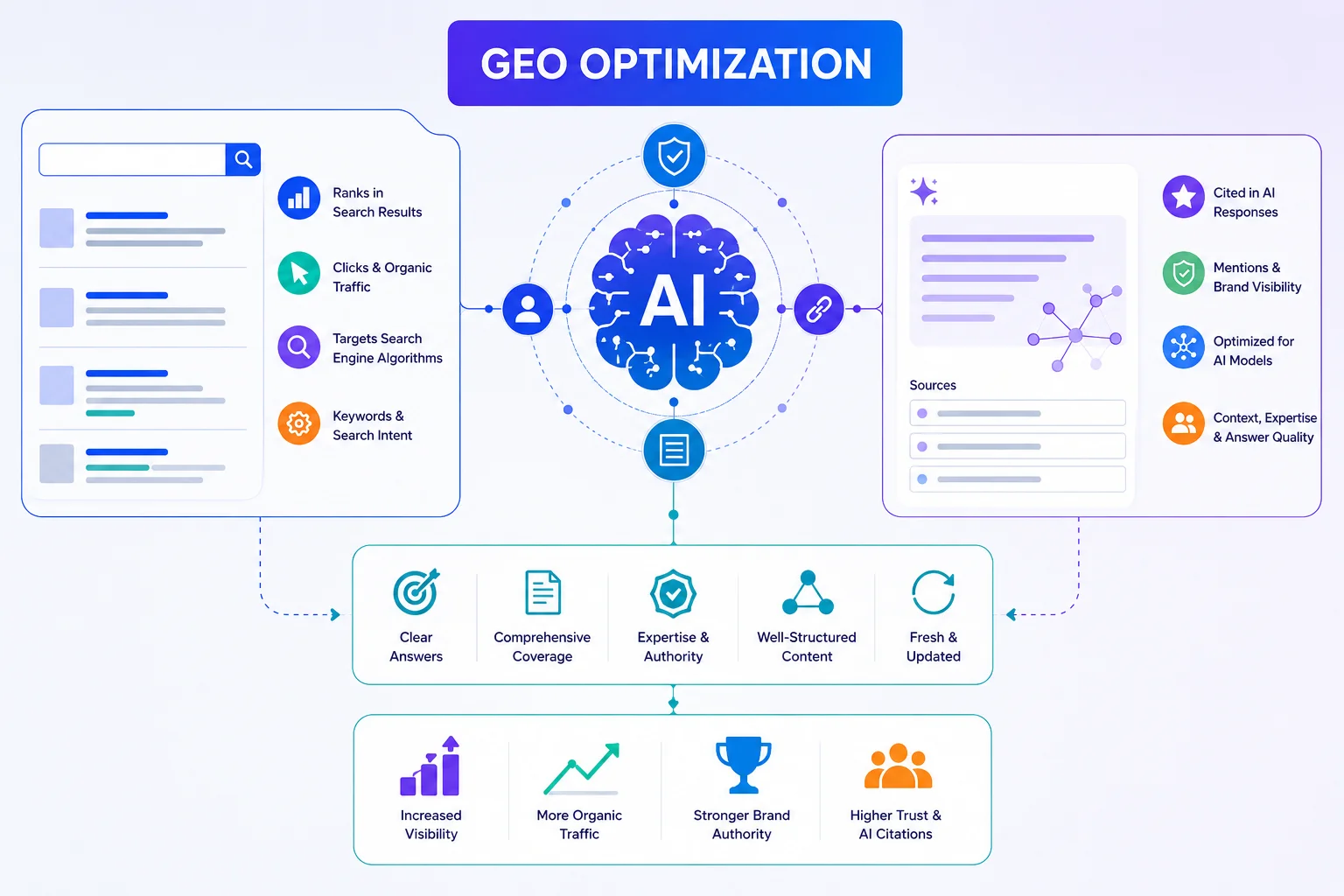
A few years ago, getting your website onto Google’s first page was the goal that shaped most digital marketing plans. That is no longer considered all that is required. Business owners are now seeing potential customers receive complete answers from AI tools before they ever click a website, making many wonder why traffic has slowed even when rankings haven’t changed much.
That shift is why many people are asking what is GEO optimization and whether it belongs alongside their existing SEO strategy. Search engine optimisation is not the solution. Making your data reliable enough for AI systems that refer to it when generating responses is the key. Businesses that rely entirely on traditional rankings may eventually become less visible as search behaviour continues to change, but those who adjust early have a greater chance of showing up in areas where customers are actively asking questions.
What Is GEO Optimization?
Generative Engine Optimisation, or GEO, is the practice of improving content so AI-powered search engines are more likely to cite, summarise, or mention it while answering user questions. When someone uses a traditional search engine to look up “best accounting software for freelancers”, ten blue links may show up. An AI assistant might compare several products, outline their benefits, and provide recommendations without requiring the customer to visit every page.
That changes the goal for your business. For AI systems to consider your content as reliable, it must be accurate, well-structured, and supported with sufficient context in addition to rating.
Why GEO Matters in 2026?
AI-assisted search is no longer just a test. These days, consumers use conversational technologies to research purchases, compare software, analyse service providers, and resolve business issues.
Rather than typing brief sentences, they pose in-depth queries, like:
- Which CRM is ideal for a small consulting business?
- How much should a local company pay for search engine optimisation?
- For a growing e-commerce business, which web platform is ideal?
These searches provide comprehensive AI-generated answers rather than just a list of links. That shift creates a different visibility challenge. For a broader look at how artificial intelligence is changing search behaviour beyond just GEO, see our guide on how AI is reshaping SEO.
How Does GEO Optimization Work?
Although every platform uses its own methods, several common patterns appear across modern AI search experiences.
1. How AI Search Engines Select Content?
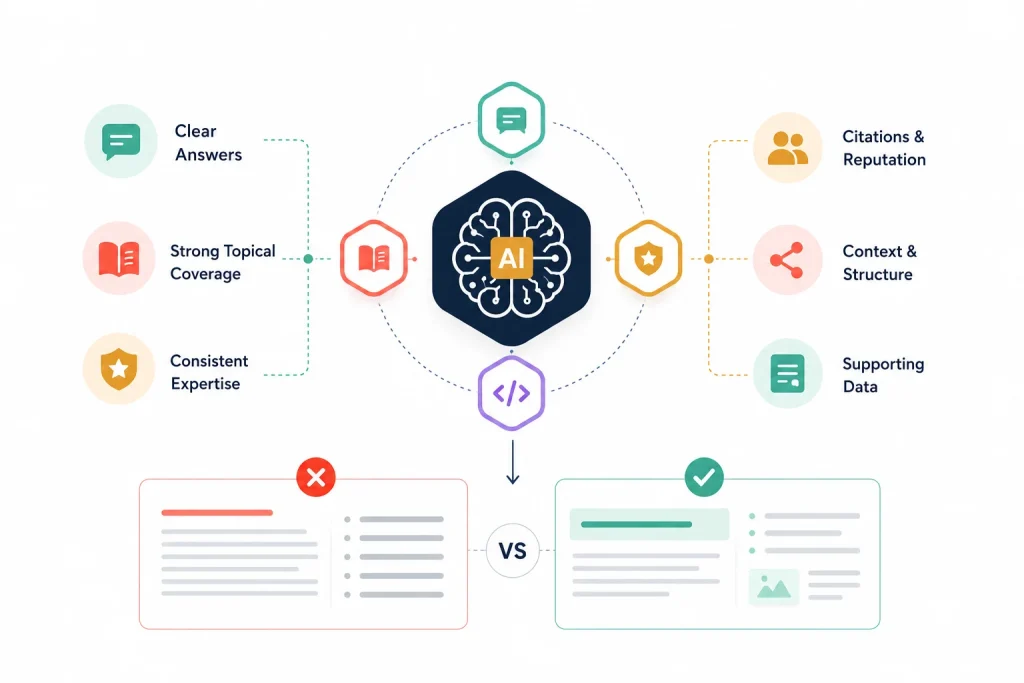
AI systems generally favour content that demonstrates four characteristics:
- Clear answers: Important information appears early instead of being buried several paragraphs down.
- Strong topical coverage: Pages explain a subject thoroughly rather than touching on it briefly.
- Consistent expertise: Related articles reinforce one another, helping establish authority across a topic.
- Technical accessibility: Clean page structure allows search engines and AI systems to interpret content more effectively, and Google’s structured data documentation outlines the standards that support this.
For example, take two articles that address the same issue.
- The first requires several hundred words to introduce the topic before moving on to the solution.
- The second provides a concise explanation that is supported by examples, analogies, and helpful guidance.
- The second approach is usually easier for AI systems to comprehend because the primary response is obvious from the start. Because of this, AI search optimisation often prioritises answer-first writing without sacrificing depth.
2. Why Citations, Context, and Authority Matter?
Some businesses assume GEO is simply adding more keywords or publishing longer articles. In actuality, it seems that AI systems place a higher importance on reputation, logical structure, supporting data, and information quality than they focus on word count.
A software company that publishes unique consumer research or comprehensive implementation guidelines, for example, might receive more referrals than a competitor that produces dozens of brief, repetitive pieces with almost identical keywords.
This is the point at when technical SEO, content marketing, and website architecture start to collaborate. Your chances of showing up in AI-powered search experiences increase dramatically if your content regularly responds to actual queries, exhibits knowledge, stays up to date, and is simple for users and AI systems to understand.
GEO Optimization vs Traditional SEO
Businesses viewed search visibility as a competition for higher rankings for many years. AI-powered search has given users another option to find information, even though rankings are still important. Users are increasingly receiving a simplified answer created from several reliable sources rather than selecting from 10 blue links.
Companies are better positioned to show up in both regular search results and AI-generated responses when they mix traditional SEO with GEO.
1. GEO vs SEO: Key Differences
Although they share many fundamentals, GEO and SEO prioritize different outcomes.
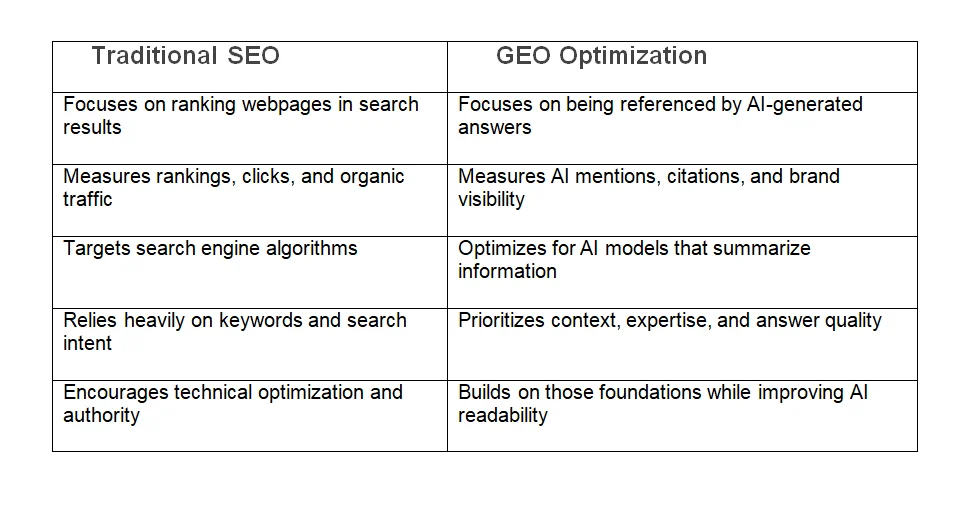
It is doubtful that a website with insufficient content, inadequate authority, or poor technological health will function well in either environment.
The distinction is that GEO asks an extra query: Would an AI assistant have enough faith in this page to include it into its response?
2. Can GEO and SEO Work Together?
They should. Many companies mistakenly believe that GEO may take the place of SEO. In reality, combining both strategies typically yields the best outcomes.
A comprehensive purchasing guide, for example, can still rank for competitive keywords and offer the organised, accurate data that AI systems might use to respond to related queries.
Instead of providing distinct content for every topic, concentrate on creating pages that satisfy both AI systems and human readers. Every kind of search experience benefits from precise information, logical structure, straightforward responses, and clear headings.
Core Principles of Successful GEO
Consistent publication standards, not isolated strategies, are the foundation of successful GEO. AI systems are built to evaluate information’s depth, quality, and dependability across time.
1. Produce Reliable, Accurate Content
AI models compare information across many sources. If your content contains outdated statistics, unsupported claims, or vague advice, it becomes less likely to be referenced.
Whenever possible:
- Provide reliable sources to support and back up statements.
- When there are changes in the industry, update the information.
- Avoid the addition of too dramatic and useless marketing language.
The distinction is noticeable to readers, and AI systems are increasingly being built to do the same.
2. Build Topical Authority
Consider a digital marketing firm that offers comprehensive resources for SEO, technical SEO, local SEO, website performance, content planning, and AI search. These articles show a deeper comprehension of the topic and support one another.
Compare that with a website that only posts one story about GEO and has minimal supporting material. The article gives fewer signs of subject-matter expertise, even if it is nicely written.
Although it takes time to develop topical authority, each excellent article enhances the overall image your website conveys. This is closely tied to what’s known as E-E-A-T; the experience, expertise, authority, and trust signals that both readers and AI systems use to judge whether your content is worth citing.
3. Structure Content for AI Understanding
Pages that answer questions clearly are generally easier for both readers and AI systems to interpret.
Small changes can have significant consequences:
- Use descriptive headings.
- Answer the primary question near the beginning.
- Group related ideas together.
- Include comparison tables where appropriate.
- Divide difficult ideas into digestible sections.
- Write naturally instead of forcing keywords into every paragraph.
4. Keep Information Fresh
Even while an article from two years ago might still have important information, its value is reduced by out-of-date screenshots, out-of-date suggestions, or outdated industry data.
Frequently, updating already-existing pages is more beneficial than continuously adding new ones.
Regularly review key information and ask:
- Have AI platforms introduced new capabilities?
- Does the advice reflect current search behaviour?
- Are statistics and references still accurate?
How to Build a GEO Strategy?
For AI search, many companies believe they require a completely new content strategy. That’s not always required. Improving the material you now have while altering the structure and planning of future content is a superior strategy.
1. Audit Existing Content
Start by reviewing your current website through the lens of AI search rather than keyword rankings alone.
Ask questions such as:
- Does this page answer the main question immediately?
- Is the data still correct?
- Are there out-of-date statistics or unsupported claims?
- Does the article show true expertise?
Rather than publishing dozens of new pages, you’ll frequently discover that your best possibilities come from making improvements to already existing ones.
2. Create Answer-First Content
Many articles spend several paragraphs building up to the answer. AI-powered search prefers the opposite.
Lead with a concise answer, then provide supporting details, examples, comparisons, and practical guidance. This structure serves both human readers and AI systems without sacrificing depth.
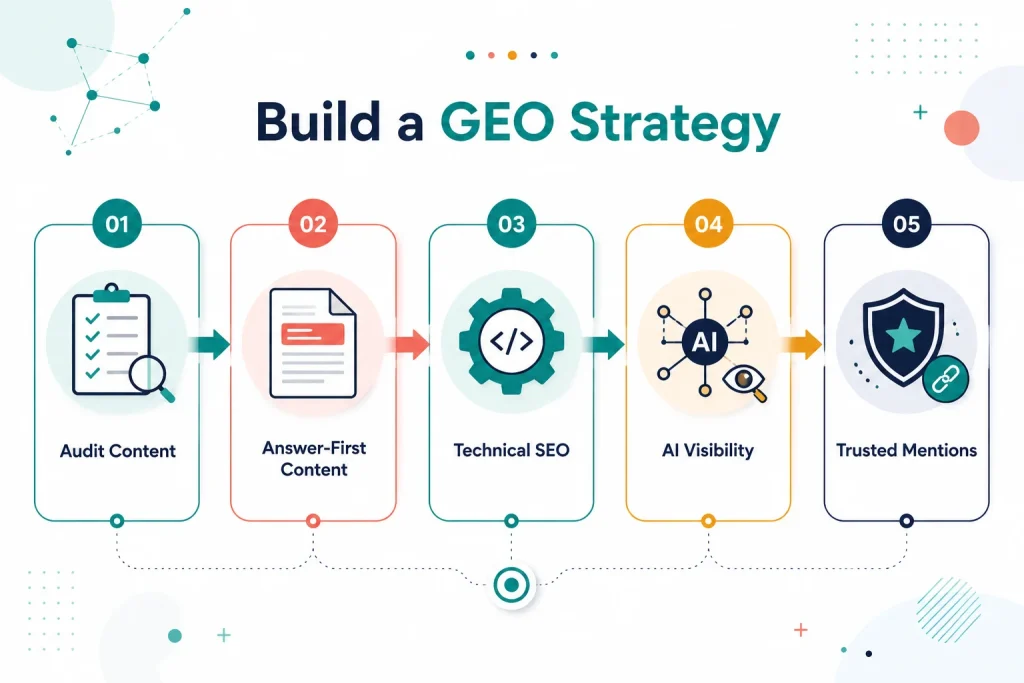
3. Improve Technical Accessibility
Be mindful of the technical principles that enable AI systems and traditional search engines to understand your content:
- Make use of informative meta descriptions and title tags.
- Enhance page speed and Core Web Vitals.
- When appropriate, include relevant structured data.
- Verify that the pages are accessible.
- Make sure URLs are clear and informative.
Technological advancements eliminate obstacles that may restrict visibility, but they won’t ensure AI citations. If you want a step-by-step way to work through these technical fixes, our technical SEO checklist walks through each of them in detail.
4. Earn Mentions and Monitor AI Visibility
Your total credibility is enhanced by brand mentions in reputable media, industry blogs, professional associations, case studies, and original research. Keep an eye on whether your brand is showing up in AI-generated responses at the same time.
Ask the questions that consumers are asking on sites like Google AI Overviews, Perplexity, and ChatGPT. If rivals frequently show up while your brand doesn’t, it’s a hint that you should examine the authority, depth, and supporting data of your material. Chasing every mention is not the aim. The goal is for AI systems to constantly identify it as a trustworthy source.
Don’t have the time or expertise to audit pages, rewrite them for answer-first structure, and fix technical issues yourself? Our SEO services can handle the strategy and execution for you, built around the same principles outlined here.
Best Practices for GEO Optimization
There isn’t a single strategy that ensures success. Rather, companies that do well in AI searches usually stick to a standard set of publishing practices.
1. Write for Conversational Search
Short keyword phrases are no longer the only ones used in searches. They want complete explanations, compare possibilities, and ask comprehensive queries. Think about the questions that someone would actually ask:
- For a small sales team, which CRM is most effective?
- Which CRM is the most straightforward to set up?
2. Create Citation-Worthy Content
Instead of repeating what thousands of websites have already said, AI systems are more likely to cite information that adds something significant. Your article will be credited rather than ignored if it contains unique information.
3. Strengthen Internal Linking and Content Structure
Establishing connections between topics is facilitated by a well-connected website. An article about GEO, for example, can organically link to relevant resources that address technical SEO, content strategy, structured data, website performance, or local SEO. These links strengthen the topical authority of your website while assisting readers in their ongoing education.
Don’t add links only for the purpose of doing so. Each internal link should direct readers to content that actually deepens their comprehension.
Measuring GEO Success and Common Mistakes
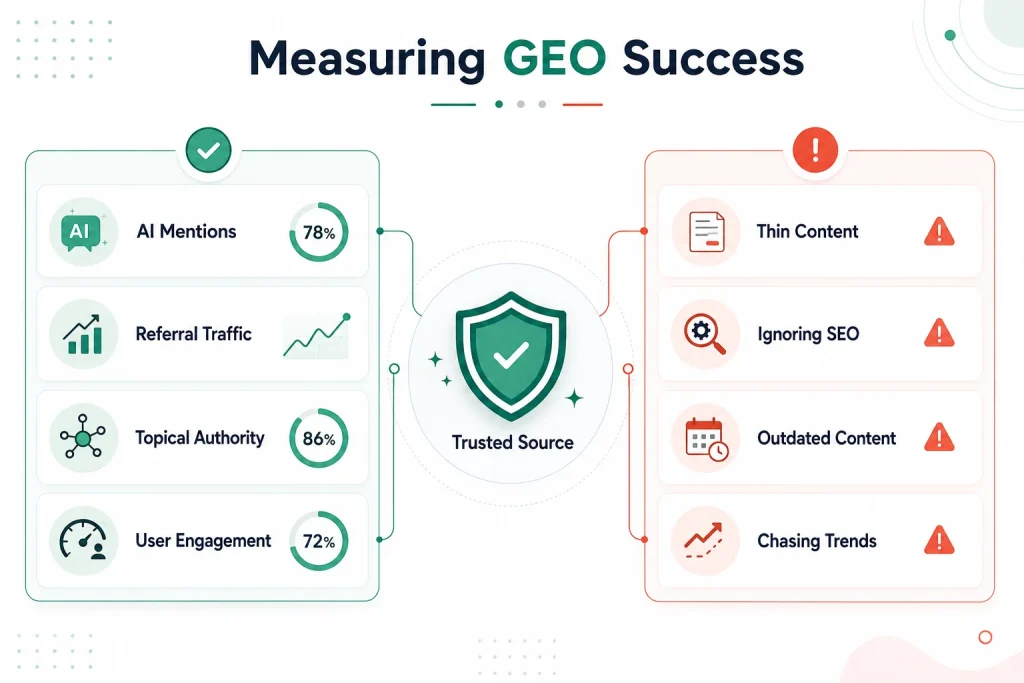
Getting more hits isn’t the only goal. It’s to increase the likelihood that your business is recognized as a trusted source when AI platforms answer concerns about your area of expertise. .
1. How to Measure GEO Performance?
Keep an eye on multiple indications at once because no single metric can reveal the complete story.
- Brand Mentions for AI: Ask the same questions that your customers would on ChatGPT, Google AI Overviews, and perplexity often. Keep track of whether your company is mentioned in the comments and how frequently competitors are mentioned in its place.
- Referral Traffic: Links to original content are available on several AI platforms. Examine your data to determine whether referral traffic from AI-powered experiences is increasing over time.
- Topical Coverage: Consider whether your website covers a whole topic or just specific keywords. Dozens of unrelated articles frequently perform worse than a group of high-quality, integrated resources. Well-implemented structured data, as outlined in Google’s structured data documentation, can also help search engines map how your content connects across a topic.
- Signals of Engagement: The depth that consumers demand is typically provided by pages that keep visitors reading, encourage them to browse adjacent resources, or inspire questions.
2. Common GEO Mistakes to Avoid
Businesses frequently slow their own advancement by making a few avoidable errors.
- Publishing content that doesn’t add much to what is already available online is a common problem. Repeating general advice rarely makes your website stand out since AI systems compare data from various sources.
- Treating GEO as a substitute for SEO is another error. No matter how beautifully an article is written, technical problems, sluggish pages, bad site architecture, and inadequate internal linking can still restrict visibility.
- Additionally, some organisations only publish the guide once and never update it. Both users and AI systems increasingly lose interest in outdated content as AI search evolves quickly.
- Lastly, don’t follow every new trend or feature in AI. First, create a collection of precise, well-structured information.
The Future of GEO Optimization
Businesses should expect ongoing changes over the next years as AI search continues to evolve.
- The emergence of agentic AI is one of the most significant changes. AI assistants are starting to perform activities including product comparison, project planning, appointment scheduling, and recommendation based on user preferences, in addition to reacting to questions.
- Additionally, search is growing more multimodal. Businesses should consider more than just written articles when creating content because users may combine text, graphics, voice, and video into a single engagement.
- The increasing significance of brand reputation is another trend. Consistent knowledge and reliable mentions on the internet are going to gain more power as AI systems continue to access information from different sources.
- Companies that successfully adapt won’t be the ones following every algorithm change. They will be the ones who regularly publish dependable material, maintain technically sound websites, and provide clearer responses to consumer enquiries than their competitors.
Not sure where to start or which pages to prioritise first? Get in touch with our team; we can review your site and map out a clear, practical plan.
Final Thoughts
Don’t rush to totally restructure your website if you’re just getting started. Make it a priority to enhance your most valuable pages, directly address customer enquiries, establish your topical authority, and maintain up-to-date content. Large, short-term projects may not produce the same long-term outcomes as little, continuous improvements.
Furthermore, it is vital to understand that GEO is not a shortcut. Trust, expertise, and credibility are developed over time.
FAQs
What Differentiates SEO From GEO?
While GEO helps your content be acknowledged in AI-generated responses, SEO enhances rankings in conventional search engines. When combined, they produce a more effective search visibility strategy.
Will GEO Take the Place of Conventional SEO?
No, by optimizing content for AI-powered search experiences, GEO enhances conventional SEO. For sustained success online, both are crucial.
Is it preferable to focus on SEO, GEO, or both?
Most businesses benefit from integrating GEO and SEO to improve visibility across search engines and AI platforms. More potential clients are reached via a combined strategy.
Which AI Platforms Should I Prioritise?
Concentrate on producing reliable, high-quality content that works well on all of the main AI platforms. As AI search develops, this makes your content future-proof.
How Much Time Does GEO Take to Show Results?
The authority of your website, the quality of your material, and the speed at which AI systems identify your content all affect GEO results. Long-term outcomes are usually improved by consistent optimisation.