Creating blog posts and driving traffic is only half the battle. If visitors leave your website without subscribing, requesting a demo, or making a purchase, your content may be missing a clear path to conversion.
A content marketing funnel helps solve this by guiding potential customers through every stage of the buyer’s journey and creating a strong content strategy. Instead of publishing random content, you create content that attracts the right audience, builds trust, and encourages them to take the next step.
In this guide, you will learn what a content marketing funnel is, why it matters, how to build one, and how to turn more visitors into qualified leads and customers.
Key Takeaways
- A content marketing funnel guides users through the journey from discovering a problem to becoming customers.
- Each funnel stage requires different content to attract, educate, engage, and convert audiences.
- Awareness, consideration, decision, and retention stages help businesses plan content strategically.
- Tracking metrics like traffic, engagement, leads, and conversions helps measure funnel success.
- A well-optimized content marketing funnel builds trust, improves customer relationships, and drives business growth.
What Is a Content Marketing Funnel?
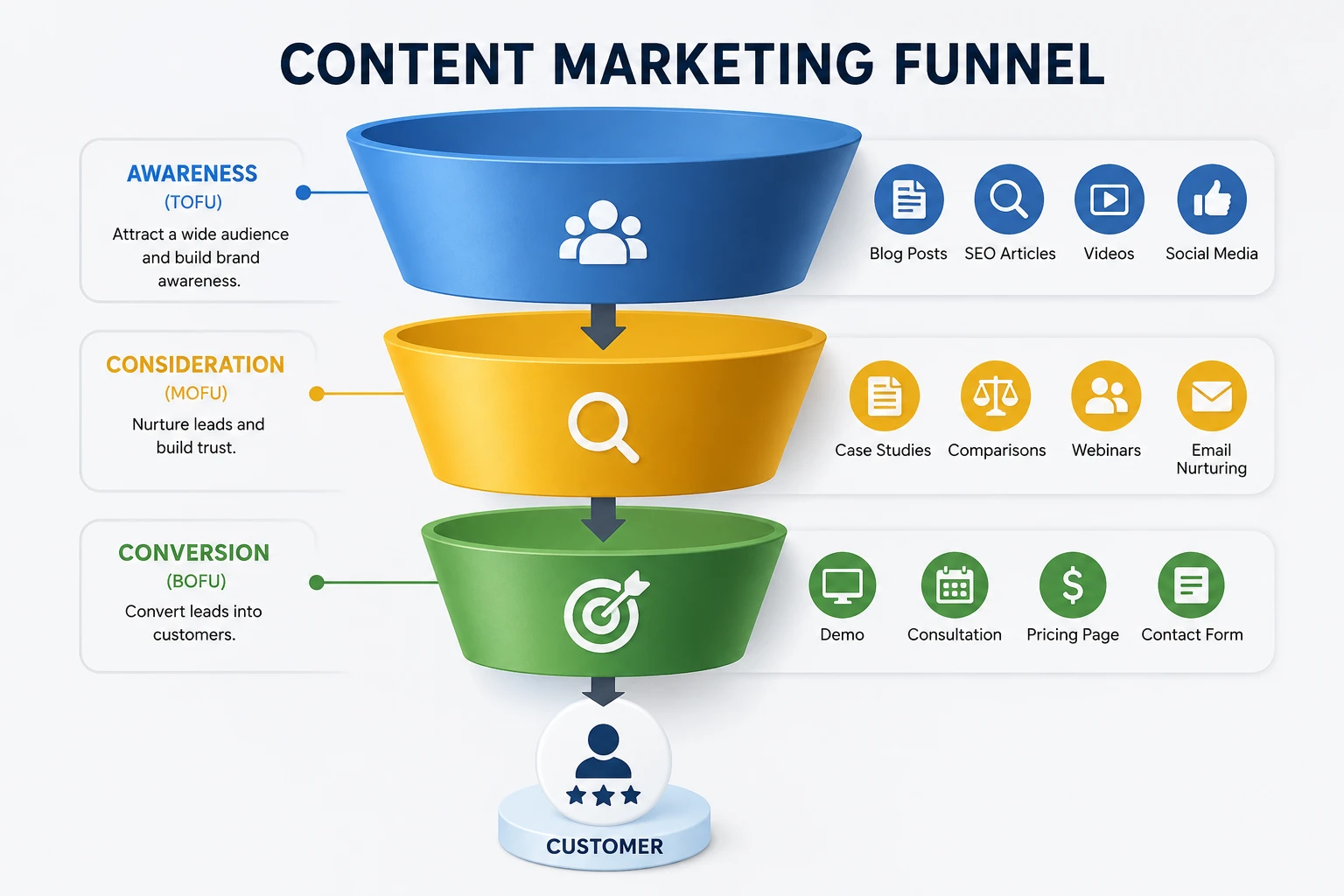
A content marketing funnel is an organized structure that assigns a specific task to each piece of content you produce based on the customer’s stage of the purchasing process.
It is the difference between random blogging and a strategic content approach. While random material may draw users, funnel-driven content draws the correct users and purposefully advances them towards an objective.
How it connects with actual consumer behavior:
- Someone is looking for an issue at the top, for example, “Why is my website slow?”
- In the middle, they are looking at possible fixes in the meantime, such as “best website performance plugins.”
- They are prepared to decide at the bottom, e.g., “WordPress speed optimization service pricing.”
Customers should be met at every stage by your content, which should provide them with the precise information they require and logically lead them to the next one.
The Value of a Content Marketing Funnel
Without a funnel, your content may attract visitors but fail to guide them toward becoming leads or customers. HubSpot reports that businesses that prioritize blogging are significantly more likely to generate positive marketing ROI than those that do not. Still, traffic alone is not enough; a funnel make sure those visitors move toward meaningful business goals.
That leak is fixed with an organized content funnel for lead creation. You could bring in clients who are genuinely likely to become customers by matching your content with search intent. More significantly, it gradually establishes authority and trust until the “ask,” a sign-up, an assessment request, or a purchase, feels not so much like a sales pitch as an obvious next phase. You generate qualified leads from passive visitors.
Need help creating a funnel that attracts, nurtures, and converts your audience? Our content marketing services can help you build a strategy focused on measurable growth.
Content Marketing Funnel Stages
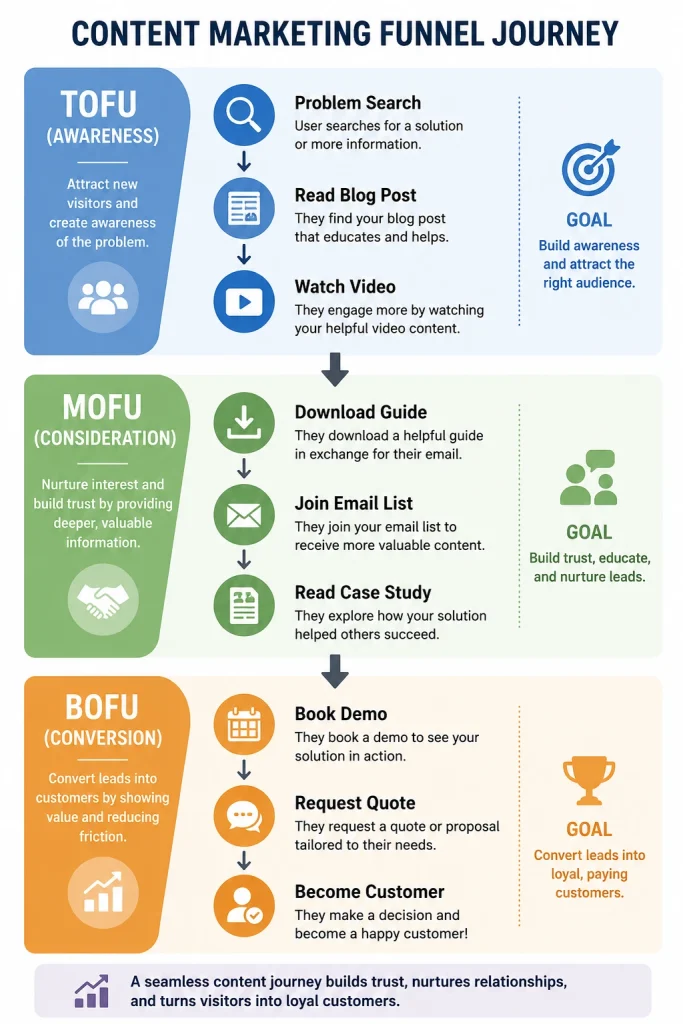
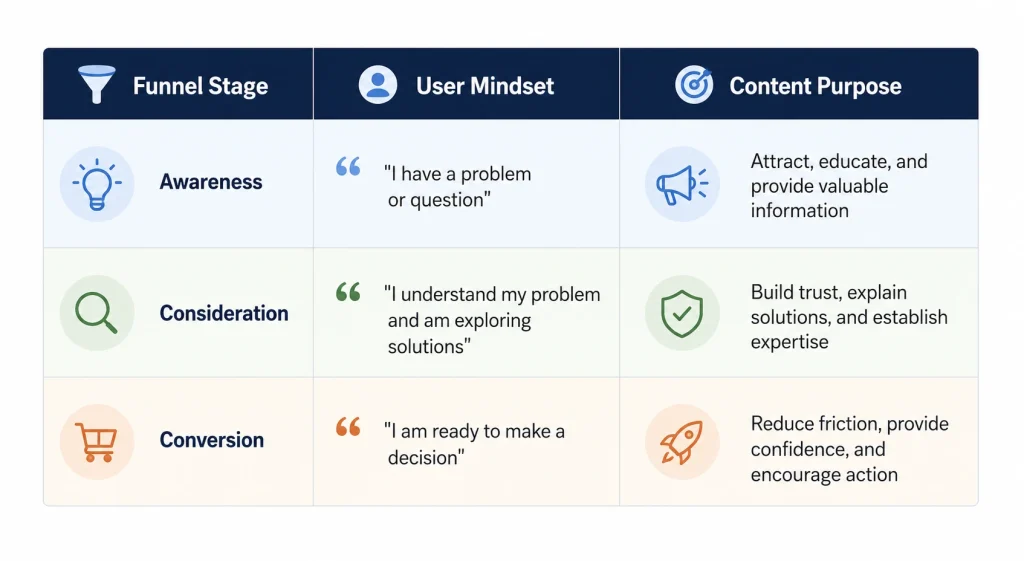
Stage 1: Awareness: Attracting the Correct Audience
“I have a problem or a question” is what users are thinking.
They conduct broad, informative, and problem-focused searches, for example, “content marketing ideas” and “how to generate leads.”
The purpose of your content: Attract, instruct, and provide value without conditions. Create awareness rather than a sale.
Stage 2: Consideration: Teaching and Establishing Confidence
“I understand my problem, and I am looking at solutions” is what users are thinking.
They look for solutions and comparisons, such as “content marketing funnel vs sales funnel” and “best email marketing software for small businesses.”
The purpose of your content: Present your solution, show off your knowledge, and go past any initial resistance. You’re becoming a reliable counselor.
Stage 3: Conversion: Converting Visitors Into Clients
“I am ready to decide, and I need to validate my choice” is what users are thinking.
Their searches are transactional, brand-focused, and specific.
The purpose of your content: Make the choice simple. Provide a clear, low-risk next step, minimize final friction, and provide social proof.
How to Create a Converting Content Marketing Funnel
Step 1: Define Your Ideal Buyer Journey
If you skip this step, the entire funnel strategy becomes ineffective. You must chart the actual route that your clients follow.
- List their main concerns, driving forces, and objections.
- Every question a customer asks at every stage, from awareness to decision, should be recorded. This list serves as a blueprint for your material.
Step 2: Match Content Types to Each Funnel Stage
Not every level is appropriate for every piece of content. What, in my perspective, is most effective:
- Awareness (TOFU): Social media videos, blog entries, infographics, and beginner’s manuals.
- Expert interviews, webinars, case studies, comparison papers, and thorough manuals are all taken into account (Middle of Funnel, or MOFU).
- Conversion (bottom of the funnel, or BOFU) is influenced by free trials, demos, consultations, pricing pages, customer feedback, and product-specific sites.
Step 3: Create Content That Naturally Guides the Next Step
The key is creating a logical path that moves users from one stage to the next. Every section should have a sensible “next step” included.
- A more thorough MOFU tutorial should be linked from an awareness blog post.
- A clear call to action (CTA) for a consultation or demo should be included in a case study.
- The quiet guide that leads readers farther into your funnel is your internal linking strategy.
Step 4: Optimize Each Funnel Stage for SEO
This is an example of content funnel mapping.
- Connect keywords to intent. According to Semrush, pages that comprehensively satisfy user intent tend to perform better in organic search because they answer more related questions and keep users engaged. “How to” keywords belong in TOFU, “vs” or “best for” keywords in MOFU, and brand + review keywords in BOFU.
- Using both broad and specific search terms, including long-tail keywords, helps target users with different levels of purchase intent.
- Make the headers, meta, and title of the page as effective as you can because of this. This helps in on-page SEO.
- By doing this, you may be able to avoid keyword competition, which occurs when several websites rank for the same term, confusing search engines and people alike.
Also check our guide on keyword mapping to see how it aligns content with every stage of the funnel.
Step 5: Add Conversion Elements That Don’t Feel Salesy
The objective is beneficial rather than pushy.
- CTAs: Change “Buy Now!” to “Read the Case Study” or “Get the Free Checklist.”
- Lead Magnets: At the MOFU stage, provide an ebook, calculator, or template in return for an email address.
- Placement: A call to action (CTA) should not appear as a pop-up the moment the page loads but rather after you’ve clearly delivered value.
Looking to strengthen your content funnel? Contact us to see how our content marketing services can make an impact.
Evaluate the Performance of Content Marketing Funnels
Pay attention to more than just page views. Metrics that demonstrate movement are essential for content marketing funnels.
- Traffic Quality: Examine the number of pages per session, intent-matched term keyword ranks, and bounce rate.
- Engagement & Progression: Monitor the download rates of lead magnets and the click-through rates of your internal links to MOFU/BOFU material.
- Conversion tracking: Determine which content paths genuinely result in form submissions, demo requests, or sales by using Google Analytics objectives.
Want to see how a strong content strategy drives real results? Check out our guide on building a content strategy for ROI.
Content Marketing Funnel Examples
The exact journey depends on the business model, audience, and buying process.
Example 1: B2B Software Company
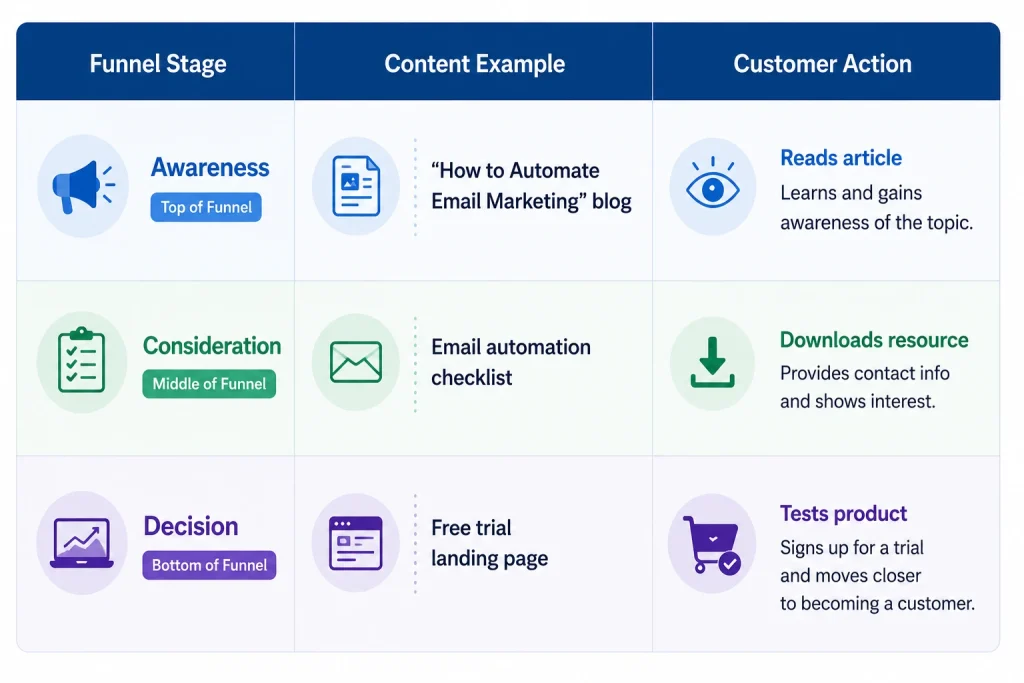
A B2B company can use a combination of content marketing, SEO, and lead generation strategies to attract decision-makers and move them through the buying journey.
Example 2: SaaS Company
A SaaS company may publish “What is marketing automation?” at the awareness stage, “Best marketing automation tools compared” at the consideration stage, and a free product demo page at the conversion stage.
Example 3: E-commerce Brand
An online skincare brand can use content to guide customers through the buying journey.
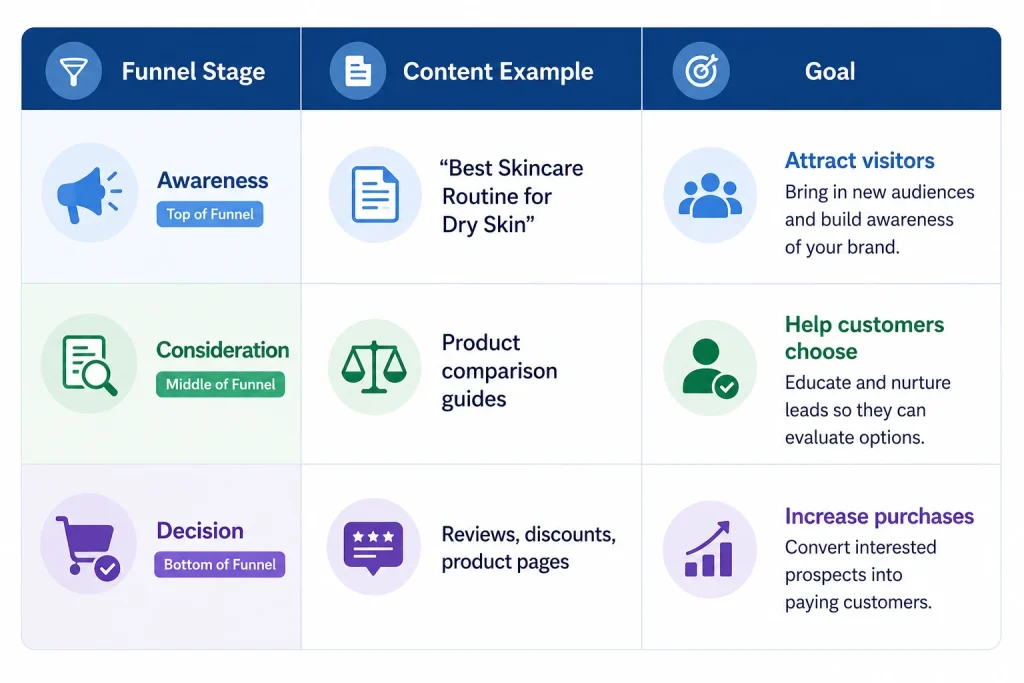
This helps customers make confident buying decisions instead of immediately pushing them toward a sale.
Looking to reach more potential customers at the awareness stage? Our social media marketing services help brands create content that builds engagement and visibility.
Content Marketing Funnel Metrics to Track
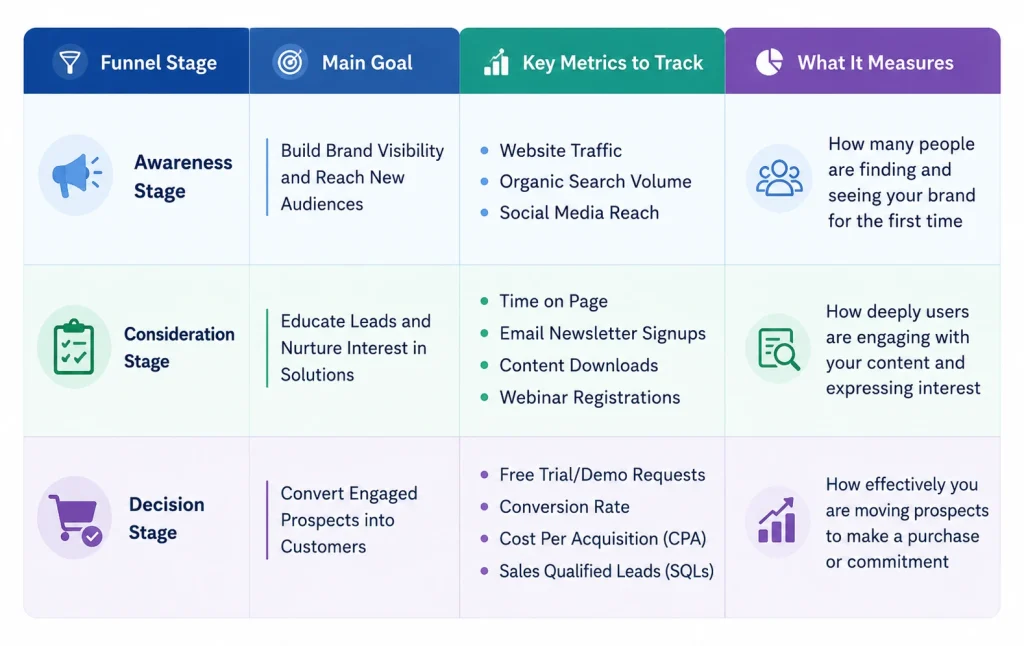
Tracking the right metrics helps businesses understand how effectively their content moves users from awareness to conversion. Each funnel stage requires different KPIs based on the customer’s position in the buying journey.
Content Marketing Funnel Tools
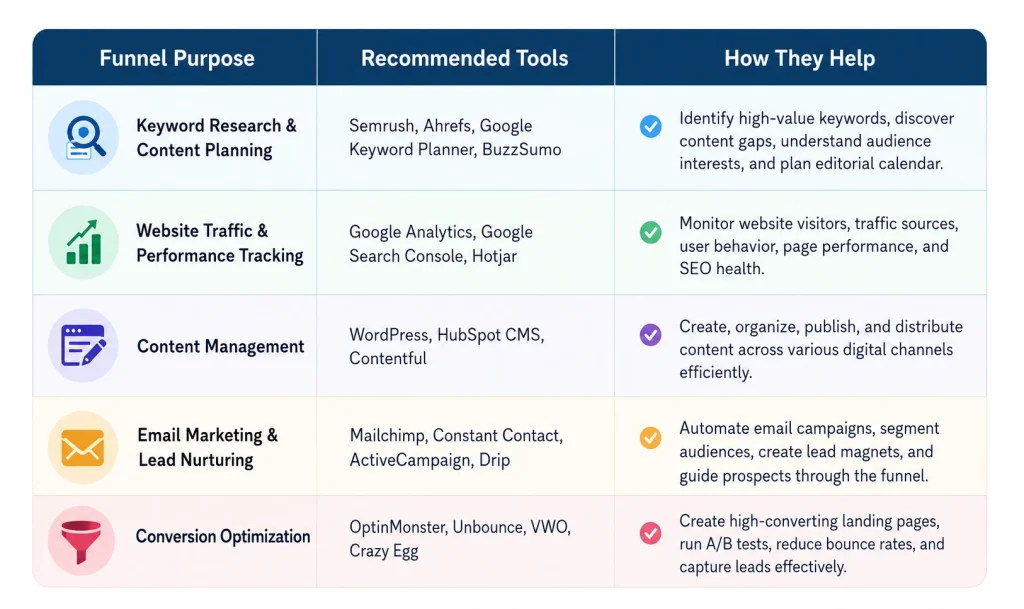
The right tools help businesses plan content, attract visitors, nurture leads, and measure funnel performance. Ahrefs has found that high-performing content often ranks for hundreds or even thousands of related keywords, making ongoing keyword tracking and content optimization essential.
Common Content Marketing Funnel Mistakes (And How to Fix Them)
1. Publishing Without Intent
- Producing content because “we need to blog.”
- Fix: Ask yourself, “Which stage of the funnel does this serve?” at the beginning of each item.
2. Over-Focusing on TOFU
- Attracting a crowd without ever directing them to take action.
- Fix: Perform an audit of the content. You should have 3-4 MOFU and 1-2 BOFU pieces for every 10 TOFU pieces.
3. Weak Internal Linking
- Giving readers no way to proceed.
- Fix: Consider each piece of material as a component of a network. Carefully connect to deeper-stage, relevant topics.
4. Ignoring Post-Conversion Content
- The sale is not the end of the funnel.
- Fix: Write newsletters that encourage loyalty, customer success stories, and onboarding content.
Learn more about where funnels break down and why funnel optimization matters.
Optimizing and Scaling Your Content Marketing Funnel
Fresh content is not always required. Often, you need better content.
- Update and Upgrade: To help readers find earlier, well-liked posts and include more thorough analysis, current data, and persuasive calls to action.
- Repurpose: From a webinar (MOFU), produce a blog series (TOFU) and a compilation of social media videos (Awareness).
- Test and Refine: Regularly test CTA language, positioning, and lead magnet offers. Your content funnel optimisation can benefit greatly from minor adjustments.
Sales Funnel vs. Content Marketing Funnel
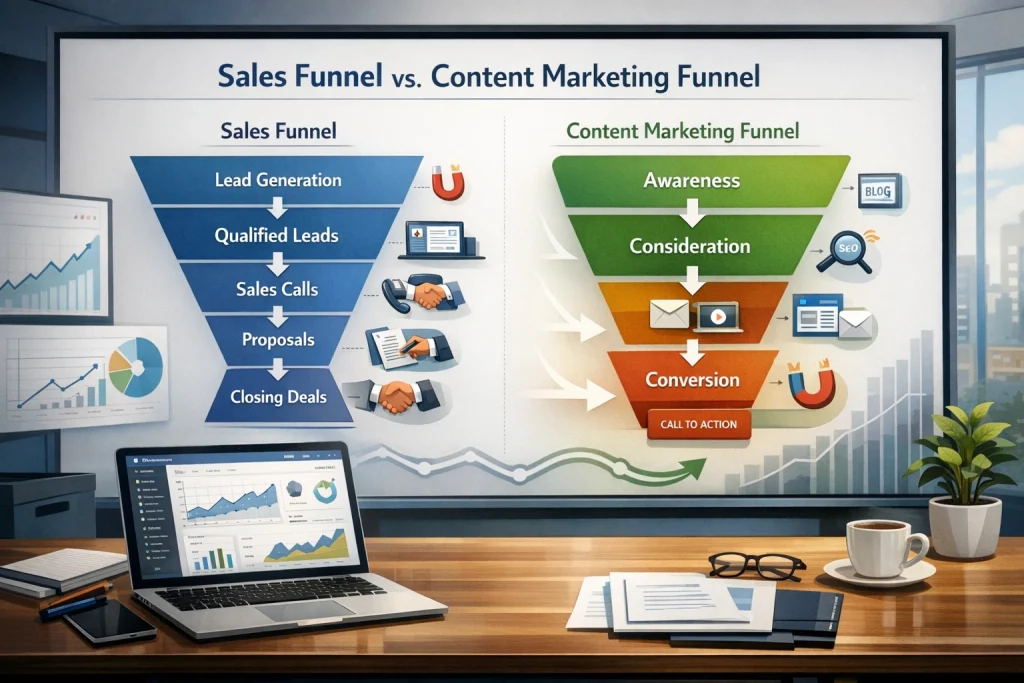
The distinction between a content marketing funnel and a sales funnel is as follows.
- The complete process a prospect goes through, typically overseen by a sales team, is referred to as a sales funnel (e.g., lead > eligible lead > request > close). It can include direct communication, cold calling, and advertisements.
A subset of that is a content marketing funnel, which attracts, nurtures, and converts individuals who are actively seeking information by using instructional and useful content.
Ready to turn your content into a conversion-focused funnel? Contact us today to discuss how a strategic content approach can help you attract qualified leads and grow your business.
Final Thoughts
Building a content marketing funnel requires constant guidance, development, and listening. “What does the audience we are targeting demand next?” is the question it poses rather than “What should we publish next?”
Start with a single piece of funnelling. Draw a single customer’s trip. Replace one outdated post with a more comprehensive and deliberate follow-up. From then, the momentum increases. When your material functions as a cohesive system, you can convert instead of merely publishing.
FAQs
Which KPIs demonstrate a content marketing funnel’s success?
Keep an eye out for assisted conversions, a drop in the cost per lead, an increase in the growth of your email list due to content updates, and above all, a clear trail in your analytics that demonstrates visitors migrating from blog posts to major conversion sites.
What is a full-funnel content strategy?
In order to make sure you are not just drawing in viewers but also actively directing them towards a business objective, this content calendar effectively distributes development and promotion activities throughout all three stages (awareness, consideration, and conversion).
Can a content marketing funnel work without paid ads?
Yes. In reality, it frequently forms the basis of an organic growth plan that is long-term and sustainable. SEO is the primary driver of a content funnel, but sponsored ads can boost high-performing funnel content.
What role does SEO play in a funnel for content marketing?
SEO helps content marketing funnels attract users by making content visible in search results. It connects your content with relevant search intent, helping users discover answers at every funnel stage.
How do you measure the success of a content marketing funnel?
You can measure funnel performance by tracking metrics such as organic traffic, impressions, engagement rate, email signups, leads generated, conversion rate, customer acquisition cost, and revenue.