
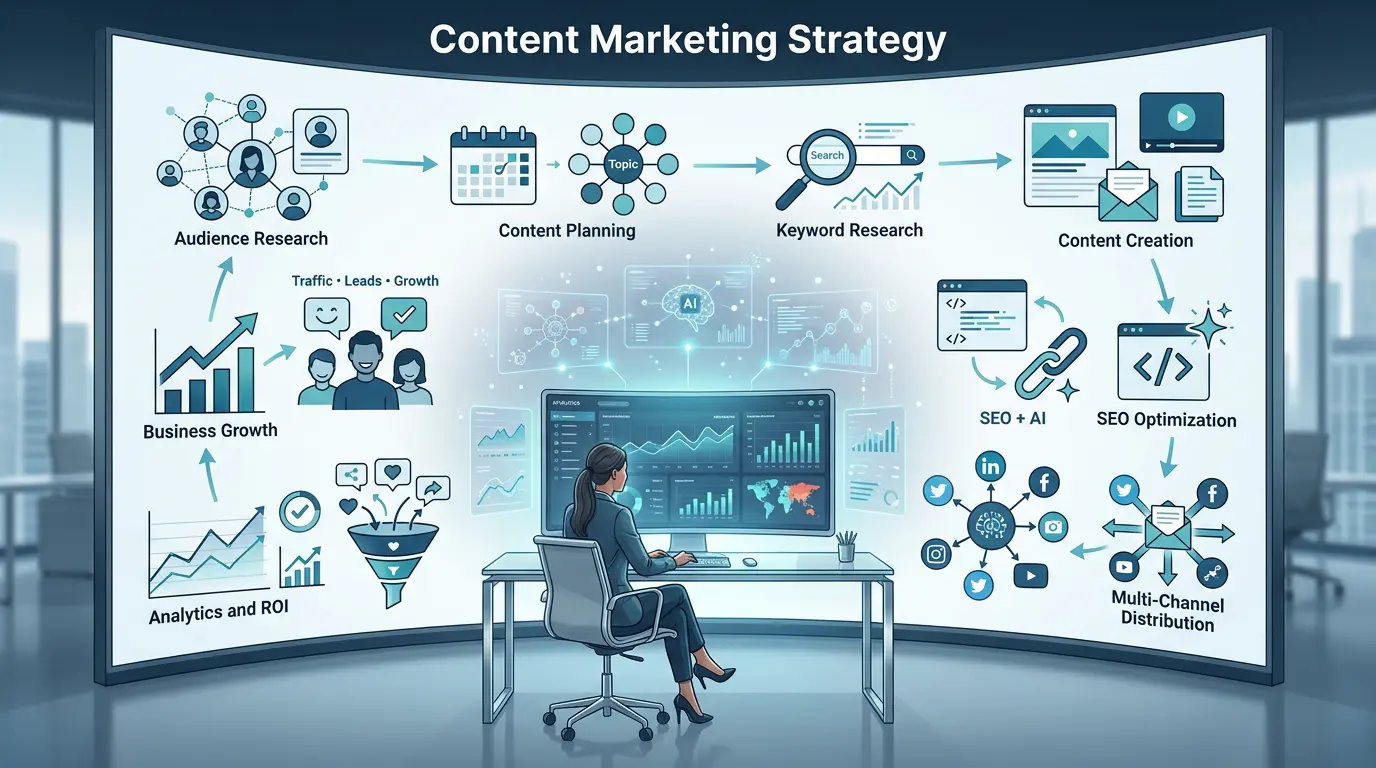
Many businesses struggle to generate qualified leads because they create content without a clear strategy. However, the lack of clear strategy is the issue rather than a lack of content. Content frequently becomes inflexible, inconsistent, and unrelated to business aims in the absence of a set structure.
A well-defined content marketing strategy 2026 helps businesses create the right content for the right audience at the right part of the consumer journey. A content marketing strategy aligns every piece of the process with measurable business goals.
Key Takeaways
- Create a content marketing strategy that meets customer demands and your company’s goals.
- To improve organic visibility, focus on search intent, topic clusters, and SEO.
- Use content marketing driven by AI to enhance planning, optimization, and research.
- Use traffic, leads, conversions, and engagement analytics to calculate the ROI of content marketing.
- Update and optimize content frequently to increase long-term traffic, leads, and business expansion.
What Is Content Marketing Strategy?
A content marketing strategy is a written strategy that helps businesses create, publish, distribute, and measure content to achieve specific marketing goals. Rather, instead of focusing only on content production, it makes sure that every article, video, email, and social media post has an important purpose. It also includes choosing the right long-tail and short-tail keywords.
Think of it as the blueprint for all effective content projects. It gives answers to inquiries alike.
- Whom are we planning to get in touch with?
- What issue are they trying to solve?
- Which types of content topics are more popular?
It’s common to mistake a strategy with a content marketing plan. The plan defines the aim of your content production and how it boosts business goals.
For example, a SaaS company may decide that educating decision-makers about automated processes is part of its strategy. Weekly blog listing, monthly webinar sessions, LinkedIn opinions, and customer case history may all be part of its content strategy.
Do I Really Want to Set Up a Content Marketing Strategy?
Yes. A defined strategy makes sure that your content continuously supports your company goals rather than being an incomplete collection of articles, videos, or social media posts.
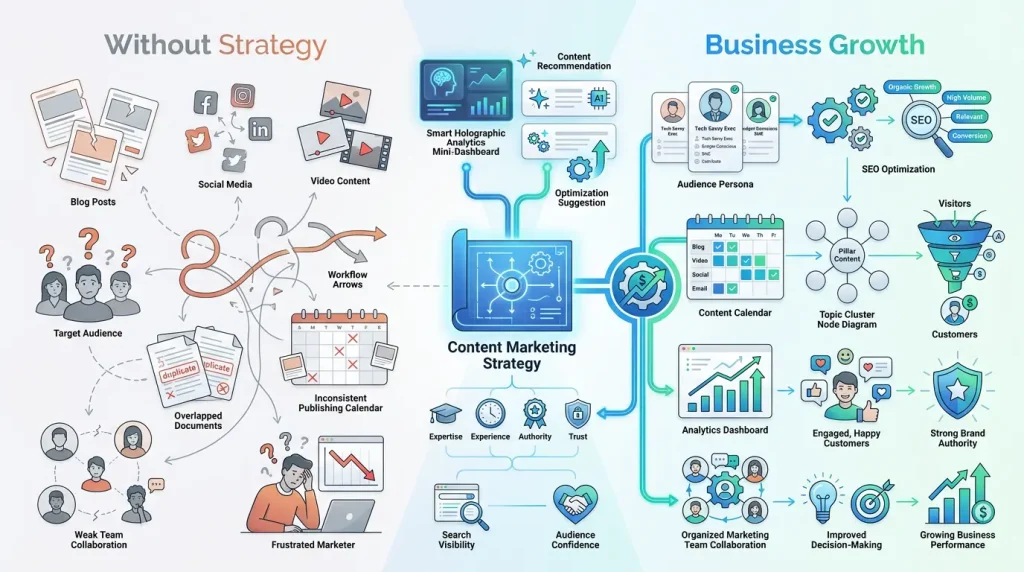
Without a strategy, businesses usually face challenges such as the following:
- Publishing irregular content.
- Targeting the false audience.
- Following trending topics that don’t modify themselves.
- Reproducing similar content.
- Weak coordination among marketing teams.
The benefits include the following:
- Finer audience targeting.
- Stronger SEO performance.
- Enhanced lead generation.
- Larger brand authority.
- Higher content effectiveness.
- Improved decision-making.
Aligning your strategy with E-E-A-T guidelines can strengthen content quality, build audience trust, and improve long-term search visibility.
How to Establish a Content Marketing Strategy in 2026?
A productive content marketing strategy 2026 needs more than just picking keywords and writing blog posts. Many efficient marketing teams use these helpful methods.
7 Steps to Making a Successful Content Marketing Strategy
1. Define Clear business goals
Your purpose may have:
- Increase qualified organic traffic.
- Generating additional leads.
- Build brand awareness.
- Improved customer retention.
- Helping product launches.
- Lower customer buying costs.
Set measurable business goals instead of publishing goals.
2. Understand your viewers
Understanding your audience also assists you in creating content for every stage of the content marketing funnel, making sure that users receive the correct information throughout their purchasing journey.
Create buyer personas that include:
- Organization.
- Job role type.
- Company size.
- Pain points.
- Buying motivation.
- Common challenges.
- Favor content layout.
For example, a B2B software purchaser frequently searches differently than an eCommerce shopper. Understanding those differences forms your messaging, content detail, and distribution strategy.
3. Conduct a content Audit
A content audit helps figure out:
- Old articles.
- Lost topics pages.
- Thin content.
- High-performing content worth updating.
- Internal linking possibilities.
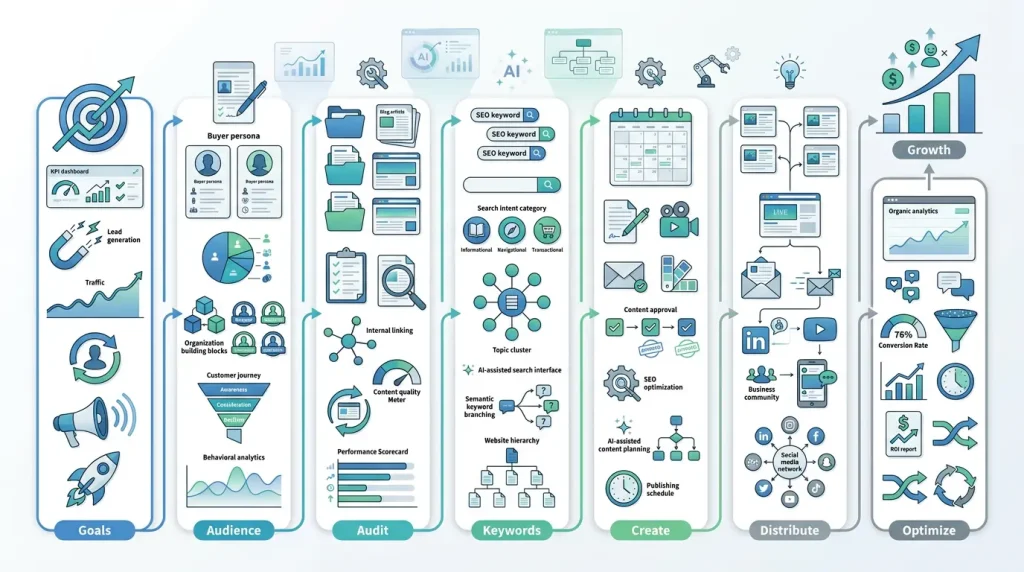
4. Perform keyword research and analyze search intent
Search intent is just as important as keyword research.
Ask an inquiry such as the following:
- What problem is the user to solve?
- Are they seeking information or comparing results?
- What part of the purchasing process are they in?
- What other queries may they have?
Organize information into connected topic collections supported by pillar pages rather than just focusing on mainly keywords.
This method helps users browse your website more easily while confirming topical authority to search engines and AI-powered search systems.
5. Create a content creation strategy
Your content creation strategy must have:
- Editorial principles.
- Publishing rate.
- Content forms.
- Content matter experts.
- Analyze the process.
- Quality measurement.
- SEO optimization workflow.
6. Establish a content distribution strategy
After publishing, distribute your content across multiple channels to ensure it reaches the right audience.
Distribution strategy may include the following:
- Organic search.
- Email marketing.
- LinkedIn.
- Facebook.
- YouTube.
- Business communities.
7. Measure, optimize, and improve consistently
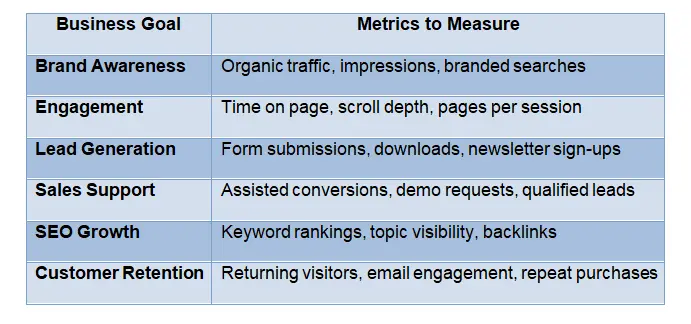
To measure success, Analyze performance on a regular basis using data points such as
- Organic traffic.
- Engagement.
- Conversion rate.
- Qualified leads.
- Keyword visibility.
- Time on page.
- Assisted conversions.
As AI-powered search gets improved, firms need to follow how their content answers natural requests and whether it remains correct, structured, and easy to sum up.
Have questions or need personalized advice? Contact us to speak with our team.
Content marketing strategy Framework
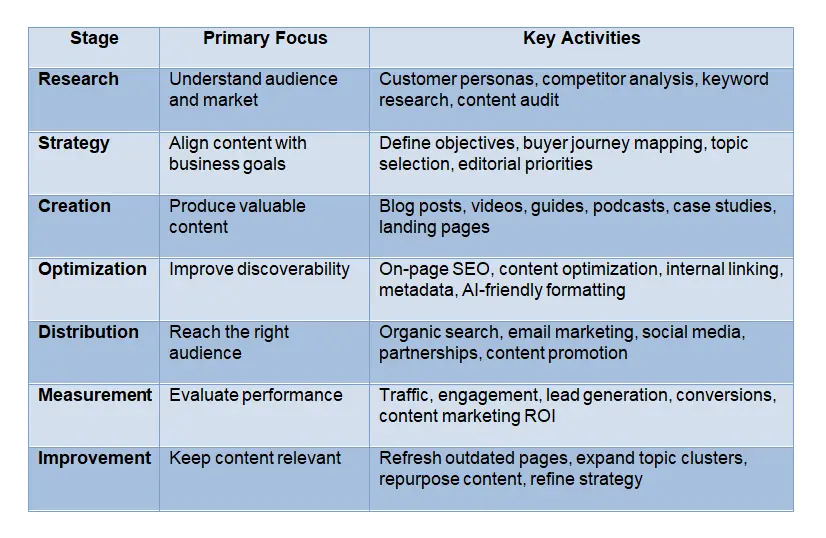
Types of Content Marketing Strategies with Examples
There isn’t a single content marketing technique that works for every business. Your audience, industry, products, sales cycle, and business goals all provide the best strategy.
1. AI-Powered Content Marketing Strategy
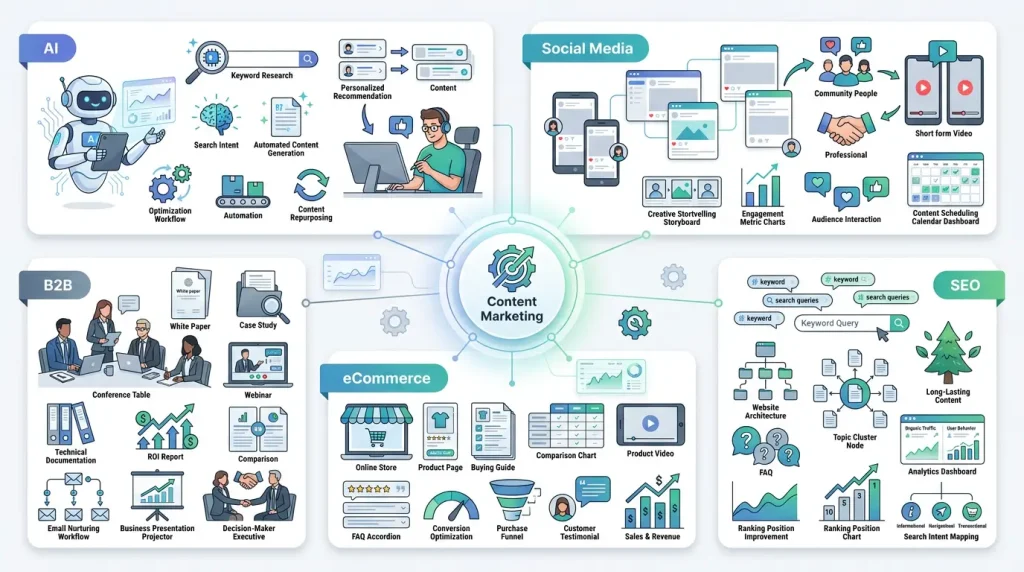
While maintaining human mastery at the center of the process, an AI content marketing strategy makes use of artificial intelligence to improve research, planning, content generation, optimization, and analysis.
- Move upward with ideas for articles.
- Create detailed content.
- Analyze search intent.
- Enhanced content optimization.
- Personalize customer experiences.
- Reuse existing information in a lot of formats.
This usually leads to unnatural writings that lack reliability and real-life experience.
For example, a digital marketing business uses AI for keyword research and content development, and its professionals create, edit, and optimize the final results for both AI search and SEO.
2. Social Media Content Marketing Strategy
A social media content marketing strategy focuses on sharing content where your audience spends the most time instead of trying to be active on every platform.
For example, different channels have different work:
- LinkedIn encourages B2B ideas, industry information, and professional networking.
- Facebook is great for community participation and small companies.
- Instagram places a high priority on brand awareness and creative storytelling.
- Long-form content, product displays, and educational lessons are all perfect for YouTube.
- Short, educational films on TikTok can boost visibility, especially for consumer-focused
Businesses.
Need help creating a social media strategy? Explore our social media marketing services.
3. Content Marketing Strategy for SEO Success
An effective SEO content strategy makes it easy for users to get reliable answers while also aiding search engines in understanding your area of mastery.
A modern SEO content strategy consists of:
- Comprehensive examination of keywords.
- Search intent analysis.
- Topic clusters.
- Pillar pages.
- Internal linking.
- Content optimization.
- Evergreen content updates.
- Structured headings.
- Useful FAQs.
For example, if your company focuses on digital marketing, one of the pillar pages can be focused on “Content Marketing Strategy.” Keyword research, content distribution, content reuse, buyer personas, and ROI measurement might all be coated in supporting articles.
If you want to improve rankings, traffic, and content performance, our SEO services can help you with this.
4. Content Marketing Strategy for eCommerce
eCommerce businesses’ efforts in highly competitive markets where consumers sometimes compare multiple products before deciding to buy one.
Among the useful content formats are the following:
- Purchasing guides.
- Product comparisons.
- FAQs.
- How-to articles.
- Product videos.
- Customer success stories.
As an example, an online supplier of fitness accessories might publish articles such as these:
- “”A Complete summary for Beginners’ Home Workouts,” “The Fastest Flexible Dumbbells for Tight Spaces,” and “How to Find the Correct Home Standard Treadmill”
5. B2B Content Marketing Strategy
Compared to B2C purchases, B2B content marketing strategy choices commonly involve more stakeholders and longer selling cycles.
Good B2B content usually consists of the following:
- Industry articles.
- White papers.
- Case studies.
- Expert webinars.
- Technical guides.
- Comparison articles.
- ROI calculators.
- Campaigns for email nurturing.
It’s a usual mistake to focus just on products rather than interacting with customer issues. Decision-makers usually want to know how a solution lowers costs, increases productivity, or addresses common problems before looking for a test.
How to Measure Content Marketing ROI?
By measuring content marketing ROI, you can resolve whether your content produces more than just page visits but also essential business effects.
For example:
- Which topics attract visitors on a daily basis?
- What kind of content creates the most leads?
- Which pages affect consumers’ decisions to purchase?
- Which channels offer the best-quality traffic?
If your business provides a local market, following traffic and conversions from local SEO can also help you measure the effectiveness of your overall content marketing strategy.
You may improve your technique and focus resources where they have the business impact by regularly evaluating these insights.
How Often Should I Freshen My Content Marketing Strategy?
As a simple rule of principle:
- Every month, analyze performance.
- On a monthly basis, analyze your strategic goals.
- Once or twice a year, conduct a comprehensive content inspection.
- Every time information becomes out of date, update existing content.
You may need to change your plan when:
- Customer needs change.
- AI search introduces new possibilities.
- Competitors start covering important topics more efficiently.
Improving already-existing, high-performing content usually results in greater outcomes than continuously producing new articles.
Tips for Content Strategy
- First, start with the query your target audience has, rather than just focus on keywords.
- Next, instead of publishing for the sake of consistency, concentrate on finding solutions to real problems.
- Then, create topic groups rather than single articles.
- Additionally, reuse content that is accessible in multiple shapes.
- Furthermore, make decisions in the future based on analytics.
- Likewise, organize teams for marketing, sales, and customer service according to shared information.
- At the same time, create content that is optimized for both traditional and AI-powered search engines by following on-page SEO best practices.
- Finally, keep your publishing timetable and editing process consistent.
Building an effective content marketing strategy takes planning, consistency, and ongoing optimization. If you need expert guidance, explore our content marketing services to create a strategy tailored to your business goals.
Final Thoughts
A successful content marketing strategy connects every piece of content to a fine business goal. Businesses that consistently create helpful, search-focused, and audience-first content will continue to earn traffic, leads, and long-term growth in 2026 and beyond.
Still have questions about building a successful content marketing strategy? Get in touch with our team for expert guidance.
FAQs
What is differentiating content strategy from content marketing?
The practice of producing, sharing, and promoting the best articles in order to attract and keep viewers is known as content marketing. A content strategy is the planning framework behind those activities.
What Are the 5 C’s of Content Marketing?
A few of the five Cs are
- Clarity: Give concepts in a way that is simple to understand.
- Consistency: Continue to provide excellent content while maintaining a uniform brand voice.
- Credibility: Provide accurate, trustworthy information backed by skill.
- Customer Focus: Address audience needs, questions, and pain points.
- Conversion: Guide readers far away from highly promotional messaging and toward beneficial next steps.
How Does Podcasting Assist a Content Marketing Strategy?
With in-depth talks, interviews, and educational debates, podcasting enables businesses to exchange knowledge. Over time, it creates stronger connections, reaches people who prefer audio material, and strengthens brand authority.