
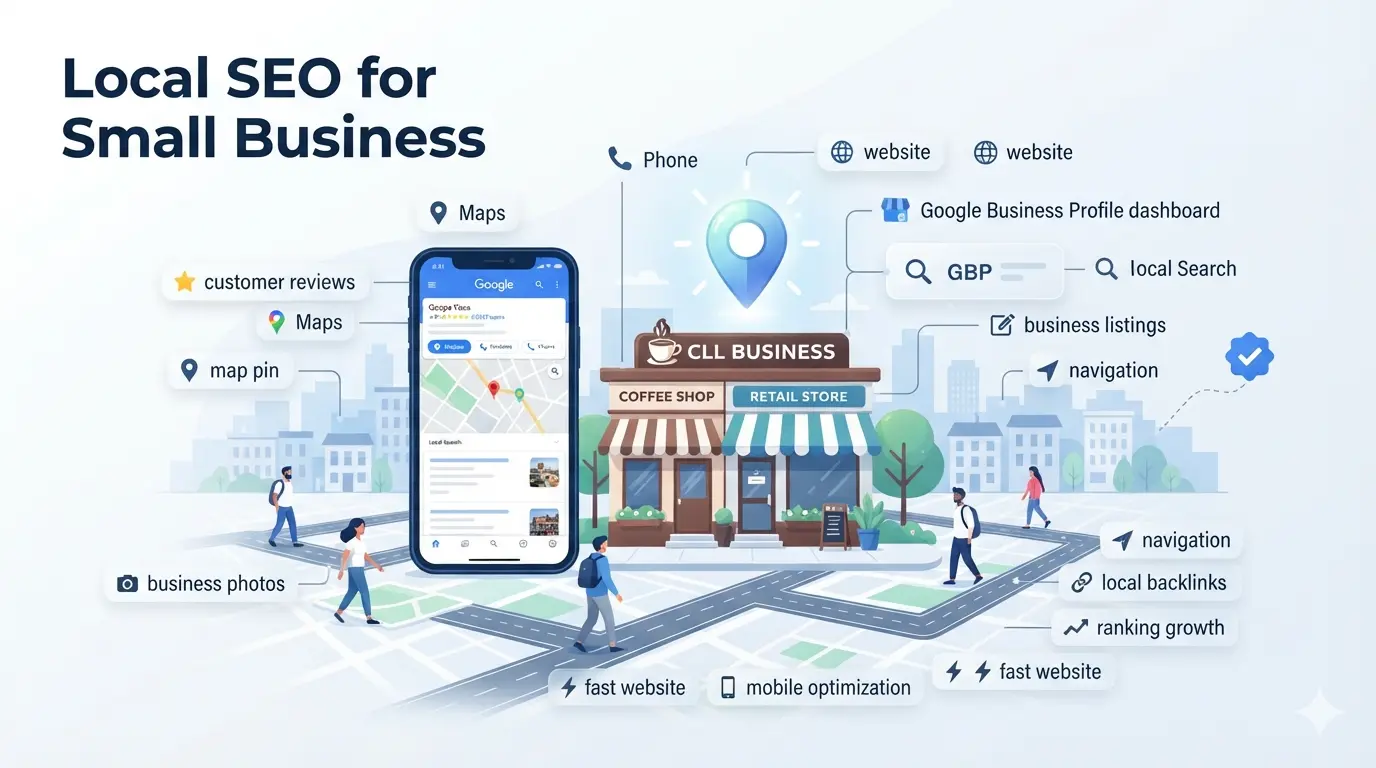
You have built a website, stay active on social media, and regularly publish content, but your phone still is not ringing with local customers. Sound familiar? For many small businesses, the problem is not their products or services. It is that they are almost invisible when people search online for businesses in their area.
Imagine someone searching for “stadium near me” or “emergency hospital in Denmark.” These searches usually have strong purchase intent. The user is not casually browsing; they are looking for a nearby business that can meet their needs immediately. If your business does not appear in those local search results, you are likely losing customers to rivals who have invested in local SEO for small business.
This is where local SEO for small business becomes important
Key Takeaways
- Local SEO helps your business show up when nearby clients search for your products or services.
- A well-optimized Google Business Profile increases your presence in Google Search and Google Maps.
- Complete business information across all online lists to make trust with search engines.
- Positive customer reviews enhance your online standing and support higher local rankings.
- Location-focused content and local keywords bring in more qualified local traffic.
- Constant local SEO efforts push long-term visibility, leads, and business growth.
Why Does Local SEO for Small Business Matters?
Local SEO aids small businesses in connecting with nearby customers who are actively searching for their products and services. Rather than competing with businesses nationwide, it improves your visibility in your intended service area. Unlike paid advertising, local SEO continues to transfer value over time as your business earns reviews, maintains correct information, and creates a trusted online presence.
More importantly, for businesses that rely on neighboring customers, local SEO for small business is one of the most essential long-term digital marketing strategies. If you are unsure about investing, learn whether SEO is worth it for small businesses.
How Does Local Search Bring Consumers?
One of the top benefits of local SEO is reaching people with greater purchase intent. Most local searches come from consumers who know what they need and are searching for nearby businesses.
For example,
- Personal lawyer in Chicago.
- Real estate agent in Denver.
is much closer to making a decision than someone searching for information about those services.s.
Local Pack Visibility
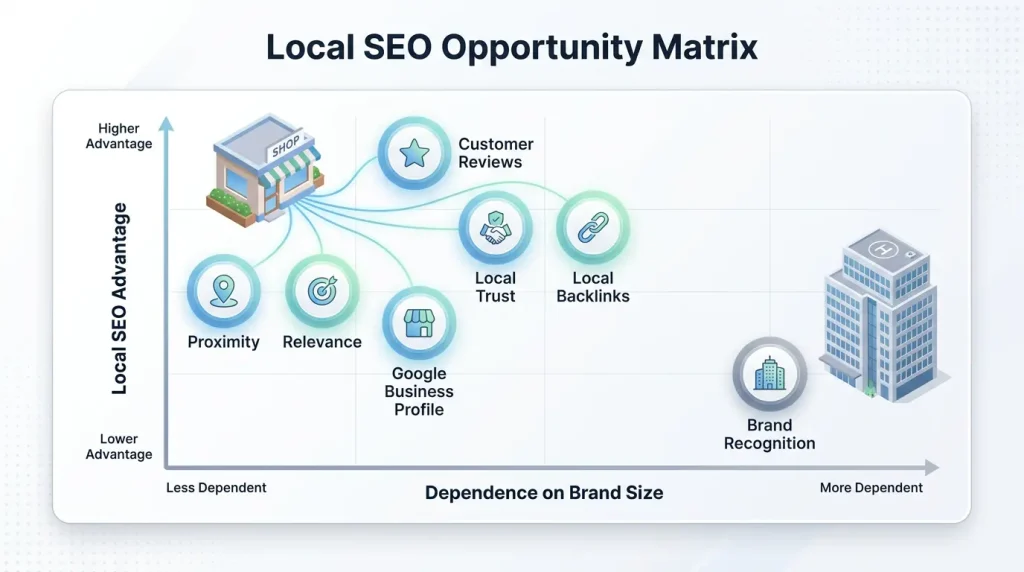
Visibility is not determined by business size alone.
Before the standard organic results, customers who conduct a local search usually see a map and three prominent business listings. This portion is known as the Local Pack.
Showing in the Local Pack offers several benefits:
- Greater visibility on search results.
- Easy access to your phone numbers, website, and direction.
- Improve trust through ratings and reviews.
- Higher click-through rates than many lower organic listings.
An entire and regularly updated Google Business Profile enhances your opportunities of appearing in local search results and Google Maps.
How does local SEO perform in Google search results?
Local SEO for small business helps Google understand your firm’s location, services, and reliability so it can prefer your business to neighboring customers.
To understand how local SEO works, it is important to know how Google evaluates local businesses.
How does Google resolve local search rankings?
Google has explained that local rankings are shaped by three guiding principles:
- Relevance.
- Distance.
- Prominence.
Rather than rely on a single ranking factor, Google combines various signals to determine which businesses best meet a user’s search.
For example, depending on where they are, a person searching for “family resort” could expect various results. Google takes analysis of each company’s closeness to the user, how well-known it is online, and how closely it fits the search query. ow well-known it is online, and how closely it fits the search query.
Importance of Google Business Profile in Rankings
Your Google Business Profile acts as one of the primary information sources Google uses when estimating local businesses.
An optimized profile aid Google understands:
- Business type
- Services
- Work hours
- Contact data
- Website link
- Service areas
- Photos
- Customer feedback
- FAQs
To learn how to optimize every part of your listing, read our complete guide on Google Business Profile Optimization, where you’ll find actionable tips for improving rankings, attracting more local customers, and increasing calls.
Local SEO Ranking Elements Every Small Business Should Know
Understanding these ranking features is absolutely necessary for building a successful local SEO for small business strategy.
1. Google Business Profile Optimization Signals
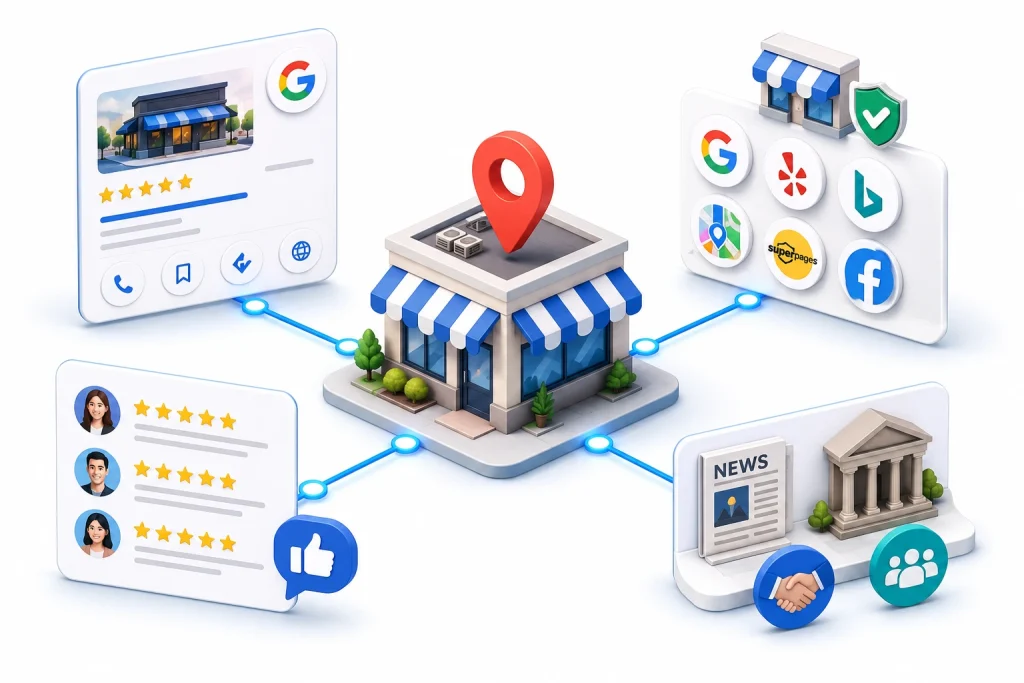
One of the best pillars of local SEO is a well-optimized Google Business Profile (GBP). It gives Google verifiable information about your company and makes it easier for clients to find out what you have to offer.
A productive profile should include:
- The accurate primary and secondary business type.
- Business description.
- Correct working hours.
- Contact data.
- Website link.
But optimizing does not stop when the profile is created.
Regularly updating photos, responding to reviews, and publishing posts aids in keeping your profile correct while building customer trust.
2. NAP uniformity Across Business Listings
NAP stands for Name, Address, and Phone Number.
Inconsistent NAP information across internet listings is one of the major common problems hurting local SEO. Search engines notice opposing signals, for instance, if one phone number is listed on your website and another list has an old number.
3. Customer feedback and Rating indicator
Feedback is considered by Google as one signal of a company’s character and stability. Businesses with authentic, current, and approving customer feedback often perform better than companies with little or old review activity, even if feedback alone will not guarantee improved rankings.
Motivate happy customers to share comments about their experiences rather than focus only on star ratings.
4. Local Backlinks and Authority Signals
Backlinks from geographically related businesses are usually more worthwhile for local SEO than unrelated national websites.
Examples include:
- Local news websites.
- Chamber of Commerce.
- Community organizations.
- Local business associations.
Focus on developing real communication within your community rather than pursuing a lot of links.
Building high-quality local backlinks is an important part of off-page SEO, helping improve your website’s authority and trust in local search results.
Local SEO Techniques for Small Business
The following step-by-step method shows the most effective local SEO for small business strategies to improve local visibility and appeal more nearby consumers.
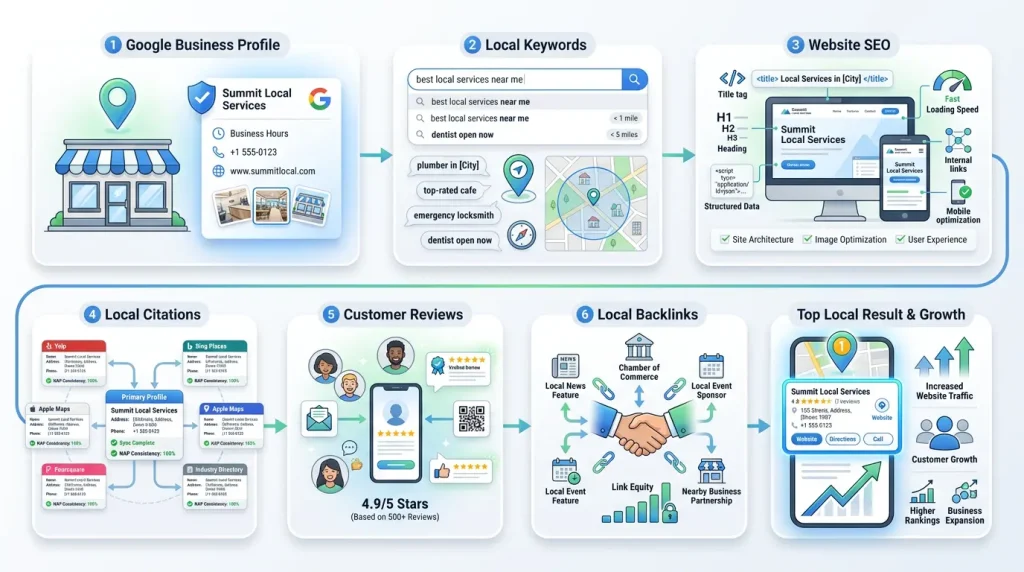
Step 1: Set Up and Optimize Google Business Profile
The first priority should always be creating and verifying your Google Business Profile if you have not already. Once verified, optimize every possible section.
Your profile must include:
- Correct business name.
- Correct business type.
- Complete address.
- Phone number.
- Website name or link.
- Business working hours.
- High-quality photos.
- Products or services.
- Business description.
After setup, keep going on maintaining the profile by refreshing information whenever changes occur.
After setting up your profile, focus on the keywords your customers actually search for.r.
Step 2: Find and Use Local Keywords Efficiently
Instead of aiming broad terms, concentrate on location-specific searches and long-tail keywords that suit how neighboring consumers actually search for your products or services.
Examples include:
- Electrician in San Diego.
- Cosmetic dentist in Miami.
- Veterinary clinic in Austin.
Research should also study:
- Nearby neighborhoods.
- Service areas.
- Local monument.
- Customer query.
- Seasonal requirements or need.
Next, make sure your website supports your local SEO efforts.
Step 3: Optimize Website Pages for Local Search
Your website should support your Google Business Profile rather than simply existing beside it.
Each service page should clearly illustrate:
- What do you offer?
- Who do you serve?
- Where do you work?
- Why do consumers choose your business?
- How can visitors contact you?
Important on-page improvements include:
- Optimized title tags
- Descriptive meta descriptions
- Clear heading structure
- Internal linking
- Fast page speed
- Mobile responsiveness
- Structured contact information
If your website is slow, old, or not easier to navigate, even strong local SEO energy may struggle to give results. Investing in professional website design and development services can enhance user experience, mobile performance, and local search visibility.
In addition, your business should appear consistently across trusted directories
Step 4: Build Local Cite and Directory Listings
Once your website has been optimized, improve your internet visibility by providing trustworthy listings with correct business information.
Local citations are online mentions of your business name, address, and phone number (NAP). Search engines use these listings to verify that your business is trustworthy
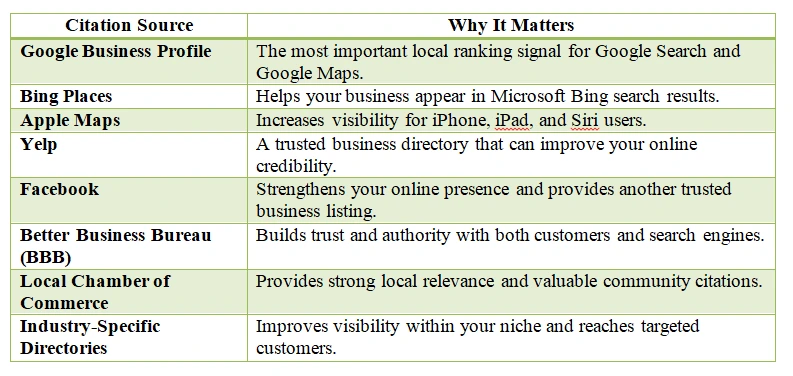
Best Practices for Managing Local Citations
- Keep your NAP complete
- Delete duplicate listings.
- Update outdated phone numbers.
- Update your address immediately.
- Audit citations on a daily basis.
Step 5: Collect and Manage Customer Feedback
Encourage satisfied customers to leave honest feedback after completing a purchase or service.
Review requests through:
- Emails.
- SMS.
- Printed QR codes.
- Thank-you pages.
can greatly increase review engagement.
Finally, build authority by earning relevant local backlinks.
Step 6: Earn Local Backlinks from Relevant Sources
After establishing a local presence, focus on evolving authority in your neighborhood.
Effective methods include:
- Supporting local events.
- Joining local business groups.
- Working together with mutually beneficial local businesses.
- Partner With Nearby Businesses.
- Write Local Guest Posts.
- Support community organizations.
- Create Local Resources.
These connections enhance your fame in your target market and usually result in useful backlinks.
Need help building a stronger local SEO strategy? Get in touch with our team to discuss practical queries for enhancing your local visibility and catch more nearby customers.
Even with a solid strategy, certain mistakes can limit your results.
Local SEO Mistakes Small Businesses Make
In many cases, Google’s algorithm is not the cause of bad local performance; rather, it is the result of preventable errors that confuse search engines or irritate users.
1. Ignoring Google Business Profile Optimization
- One of the most common errors is setting up a Google Business Profile and then not updating it.
- Some companies check their profile, add a few basic contact details, and consider the job finished. On the other hand, an insufficient or old profile could limit your publicity in local search results and damage client confidence.
- Treat your Google Business Profile as a part of your customer service rather than a one-time setup effort.
However, your Google Business Profile performs best when it is supported by strong on-page SEO and informed by effective keyword research, helping search engines better understand your business and its services.
2. Inconsistent Business Listings Across Platforms
- Inconsistent business information is one of the most typical local SEO problems.
- An internet listing may list an outdated phone number from years ago, but your website might only show one. Similarly, using multiple names for your address on multiple platforms can result in unnecessary inconsistencies.
- Although these differences might not seem like much, they have the ability to eat away trust among search engines and potential clients.
These issues are just one example of why businesses should understand the different types of SEO, as technical, on-page, and local SEO all work together to improve search visibility.
3. Keyword Stuffing Instead of Natural Optimization
- In the past, a popular SEO strategy was to often spread keywords across a webpage. Today, it usually damages readability without boosting ranks.
- Rather than using awkward sentences like “Best plumber in Chicago providing Chicago plumbing services for Chicago homeowners…”.
- Focus on generating material that communicates your location and services in a natural way.
4. Not Collecting Enough Reviews
- Many delighted customers are willing to post reviews—but they just are not asked.
- Instead of using a daily basis review process, businesses frequently rely on occasional client input.
5. Weak Mobile Optimization
- Nowadays, smartphones are used for the majority of local searches.
- Potential clients might leave your company before getting in touch with you if your website loads slowly or is challenging to use on mobile devices.
How to Measure Local SEO Performance and Success?
Measuring results is a prominent part of local SEO for small business because it shows which techniques are producing visibility, leads, and customer queries.
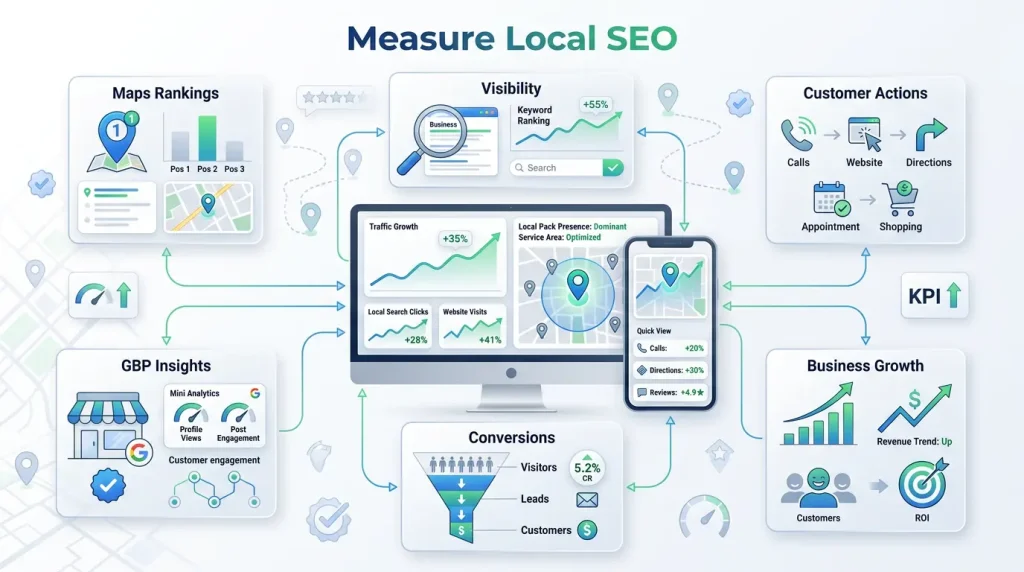
1. Monitor Local Search Visibilitys Rankings
Monitor how your business appears for your most important local keywords within your service areas.
Keep in mind that Google Maps rankings vary based on:
- User location.
- Search history.
- Device.
- Search intent.
Rather than checking rankings manually every day, use local rank tracking tools to identify long-term trends.
2. Measuring Calls, Directions, and Website Clicks
Local SEO should ultimately generate customer actions. Useful engagement metrics include:
- Phone calls.
- Website visits.
- Requests for directions.
- Appointment bookings.
- Contact form submissions.
- Online purchases (if applicable).
If rankings improve but customer inquiries remain unchanged, review your website experience, calls to action, and conversion process.
3. Using Google Business Profile Insights Data
You can learn a lot about how customers engage with your listing using Google Business Profile Insights. These insights are useful in determining which services are most popular and how consumer behavior evolves over time.
4. Evaluating Conversion from Local Traffic
- The most useful indicator of local SEO performance is whether local visitors become
- For instance, a 20% increase in traffic might look encouraging, but further optimization would be required if inquiries do not change.
- Local SEO should always be judged based on business growth—not rankings alone.
- In the end, long-term success comes from consistent optimization rather than quick fixes.
If you are looking for a strategy to improve your local rankings, produce more leads, and grow your business, contact our team today to discuss how we can assist.
Final Thoughts
Local SEO for small businesses helps them become more seeable to nearby customers who are prepared to take action. By maintaining correct business information, earning consumer trust, and constantly optimizing your online presence, you can enhance your visibility in Google Search and Google Maps while helping long-term business growth.
FAQs
Does Local SEO Still Work Today?
Yes. Local SEO is incredibly effective since buyers continue to look online for neighbourhood companies. While Google’s algorithms improve, businesses that maintain accurate information, create helpful content, and deliver positive customer experiences continue to benefit from excellent local presence.
What Separates a Local SEO From Traditional SEO?
While traditional SEO focuses on building presence across broader search results, local SEO targets customers in a specific area.
Is a Google Business Profile Enough for Local SEO Success?
No. While a Google Business Profile is important, it represents only one aspect of local SEO.
Is It A Good Idea to Use Local SEO?
For businesses who are dedicated to local customers, local SEO is often one of the best digital marketing investments.
Why Are So Many Businesses Spending on Local SEO?
Customers are increasingly using mobile and location-based searches. Companies understand that showing up in local search results can boost exposure and improve reputation without depending entirely on sponsored advertising.
Can I manage local SEO myself?
The basics of local SEO, such as optimizing their Google Business Profile, maintaining accurate business information, obtaining customer reviews, and producing useful website content, are manageable for many small businesses.